
1. Where Does API Characterization Fit in Product Development?
As soon as an active pharmaceutical ingredient (API) is discovered, companies race against time to market a finished drug product. As the saying goes, time is money! The work done upstream can prevent obstacles along the way to smoothly reach the finish line.
Investing in drug development includes characterizing the API to better understand how to formulate the desired drug. If pre-formulation studies are well executed, the formulation will deliver the treatment as intended.
During each development phase, studies confirm the stability of the drug over time. Methods to assess the stability of the API must be developed and validated; these methods are needed to confirm that the API remains intact through each step of formulation development. Again, the API must be well characterized and well understood to facilitate the development of analytical methods.
Every small and big decision will take into consideration the characteristics of the API to ensure its stability, for example, the careful selection of excipients, container, and dosage form.
Again, at later stages, including manufacturing trial batches, clinical batches, and commercial batches, the API will be tested continuously to assess its stability.
Early API characterization plays a decisive role in formulation success, scale‑up readiness, and regulatory outcomes. When key physicochemical properties are not fully understood early, development teams often face avoidable reformulation work, manufacturing challenges, and delays later in the lifecycle.
This paper is intended for R&D and development teams and outlines how thoughtful API characterization can reduce these risks and support formulation choices, stability, scale-up readiness, and manufacturability.
2. Why API Characterization is a Development Risk Lever (Not a Lab Exercise!)
At this early stage, many critical development decisions are made long before manufacturing is ever discussed. When API characterization is treated as a checkbox rather than as a development strategy, formulation complexity, scale‑up feasibility, and even regulatory risk are often underestimated.
In practice, this early collaboration starts with the development work performed in the laboratory. Before heading to manufacturing, research and development must provide a process that is robust and reproducible to obtain the desired drug product.
Everything must start in the laboratory! Scientists develop formulations based on the physicochemical characteristics of the drug substance, allowing the active pharmaceutical ingredient to be delivered safely and effectively to the patient.
API properties guide the selection of compatible excipients and appropriate packaging materials (including container, cap, and dosing device).
Early work can prevent later-stage failures and setbacks, which may be the degradation of the active ingredient under certain conditions, reactivity of the active ingredient with an excipient, rheology, interaction with the packaging, scale-up drift, and so much more.
3. Drug Substance and its Characteristics
Before we get into formulation and scale-up, we must start by understanding the API's physicochemical properties, as well as where/how it must be delivered. Each delivery site, skin, mouth, or nose, has a different mechanism of drug absorption. Therefore, the formulation will modulate API characteristics to render the drug available in the right location.
The discussion of each characteristic emphasizes its importance and how disparity can impact drug development.
3.1. Baseline: Identity, Purity, and Stability
The API is initially tested for identity, purity, and stability. Some of the most basic tests include color, melting point, refractive index, and pH in solution.
The color of a substance provides a quick assessment of purity: a color change can happen over time, upon heating, or while exposed to air. The color change can indicate decomposition and the presence of impurities. The conditions upon which a compound decomposes must be monitored and recorded; these conditions are then considered when formulation development is initiated.
A melting point is a physical property that allows not only the identification of a compound but also the assessment of its purity. A narrow melting point will likely indicate the presence of a single component.
However, a broad melting point can indicate the presence of an impurity, including residual solvent(s), or the presence of polymorphic forms, for which each form can melt at slightly different temperatures. The former can impact the safety of the drug product, and the latter can impact the solubility and bioavailability of the drug product.
3.2. Solid-State Properties: Polymorphism
Substances can adopt different polymorphic forms. Indeed, a drug substance may appear pure because it contains only one type of molecule, but its crystalline arrangement may vary. Polymorphic form variations may arise from different purification methods, for instance, when different recrystallization solvents are used.
As an example, below are the two main crystal structures for paracetamol. Form I is a monoclinic structure, which appears to be more thermodynamically stable, leading to a lower solubility. Form II is an orthorhombic structure, which is qualified as metastable and tends to be more easily solubilized.
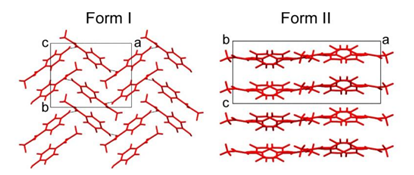 Figure 1: Crystal structures of paracetamol
Rigorous tests must be performed when the crystalline form can impact solubility. Indeed, different crystalline forms may have different particle dimensions, density, and surface area, which may affect the rate of dissolution and solubility. The impact of these differences in physical properties of various polymorphic forms may become more significant when the formulation is scaled up.
Once established, the preferred polymorph must be manufactured reproducibly, and confirmation of this through routing testing is an essential part of the API characterization and quality control processes. This will ensure a robust, reproducible, and scalable formulation and eventually provide a consistent drug product.
In the drug product manufacturing process, as we will see, the crystal form will also be monitored and controlled in the scale-up and manufacturing processes to ensure that it remains stable when the API is in suspension.
3.3. Particle Size and Why it Matters Beyond Dissolution
Similar to crystal form, particle size can have a significant impact on both dissolution rates and, hence, bioavailability and stability. Particle reduction increases surface area and, therefore, improves the dissolution rate of the substance. When the surface area of solute particles is increased, in this case the API, the interactions with the solvent(s), here the excipient(s), are effective and the API will dissolve efficiently.
In order to control the impact of this property, the particle size of APIs is often controlled and part of their specifications. Depending on the drug substance manufacturing process, additional steps can be taken to achieve the desired size and distribution of particles.
At the drug substance level, examples of techniques include milling, micronization, and spray drying. Particle size can also be modulated as part of the drug product manufacturing process through milling and high-pressure homogenization, for example.
Early characterization of particle size is essential, as it may influence the appearance and texture of a semi-solid, as well as the absorption rates of suspensions. In these early stages of drug development, knowledge of the desired pharmacokinetic profile of the drug, especially the absorption stage, will be important to ensure effective drug delivery and efficacy.
This is well known for oral drug delivery, but topical drug delivery, whether dermal, for local treatment, or transdermal, for drug delivery through the skin to another therapeutic site, will be impacted by particle size if the API remains in suspension in the formulation.
Indeed, the API can cross the stratum corneum, the outermost layer of the skin, via the transcellular, the intercellular, or the appendageal route. The absorption is controlled by passive diffusion; as such, the API is released from the formulation to diffuse towards the stratum corneum and then through it.
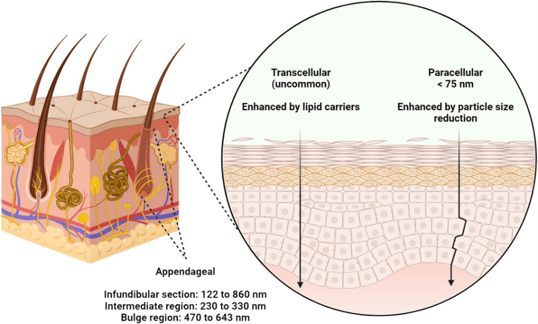 Figure 2: Particle size required for drug delivery through skin.
3.4. Water Content, Hydration, and Hydroscopicity
Water content in an API is measured to determine if the drug substance is in a hydrated form, which occurs when water molecules are incorporated in a specific stoichiometry, often through hydrogen bonding interactions, in the crystal lattice of the substance. Hygroscopic substances easily become hydrated when exposed to moisture, and their molar masses vary according to the number of water molecules incorporated.
Because hydrates can have different physical properties than their anhydrate counterparts, the API must be available in a single form. When multiple forms are present, it is not possible to measure an accurate amount of the API.
Formation of hydrates can also affect the stability of a drug substance. Therefore, it is important to determine if the compound will retain its structural integrity when exposed to water at various temperatures.
For example, acetyl salicylic acid (ASA or aspirin) hydrolyzes in the presence of water over time; ASA decomposes into salicylic acid and acetic acid (vinegar), hence the vinegar odor when an aspirin bottle has long expired!
%20to%20salicylic%20acid%20and%20acetic%20acid.png?width=398&height=132&name=Acid%E2%80%90catalyzed%20hydrolysis%20of%20acetylsalicylic%20acid%20(aspirin)%20to%20salicylic%20acid%20and%20acetic%20acid.png)
Figure 3: Acid‑catalyzed hydrolysis of acetylsalicylic acid (aspirin) to salicylic acid and acetic acid.
A physically stable form, anhydrate and/or hydrate drug substance, must be identified and monitored to ensure a long shelf life of the drug product.
Ideally, drug substances will maintain their physical stability under the various environmental factors, including relative humidity, temperature, light exposure, and pH. When possible, parameters are controlled with appropriate packaging, for example, using an amber bottle rather than a clear bottle for light-sensitive compounds.
3.5. Solubility and Dosage Form
The drug substance will be tested for solubility in various nonpolar and polar solvents to find the perfect match when designing the drug product.
Topical formulation is designed to obtain the desired concentration of the API in the drug product. The ideal concentration can be achieved by using a mixture of miscible cosolvents, a solvent in which the active is highly soluble, and a solvent in which the active is poorly soluble; the proportions of solvents are adjusted to obtain the desired concentration.
On the other hand, oral suspension formulations require a solvent in which the active ingredient is poorly soluble or nearly insoluble in the liquid phase. Oral suspensions can be favored to reduce the bad taste of an active ingredient or to facilitate patient intake of the medicine through the mouth.
3.6. Enantiomeric Purity (When Relevant)
Enantiomeric purity may be important to assess, especially when chiral molecules have different effects on human beings, including odor, taste, and biological activity.
Historically, drugs were often produced and sold as a mixture of enantiomers (called a racemic mixture when the ratio of each enantiomer is 50:50). Ibuprofen is sold under different trade names (Motrin and Advil) as a racemic mixture, but only one enantiomer is active as an analgesic and anti-inflammatory agent. The inactive enantiomer is actually racemized into the active enantiomer when ingested and metabolized.
-ibuprofen%20and%20the%20inactive%20(R)-ibuprofen..png?width=404&height=118&name=Enantiomers%20of%20ibuprofen%20the%20pharmacologically%20active%20(S)-ibuprofen%20and%20the%20inactive%20(R)-ibuprofen..png)
Figure 4: Enantiomers of ibuprofen: the pharmacologically active (S)-ibuprofen and the inactive (R)-ibuprofen.
As mentioned above, the activity of chiral drugs can vary between enantiomers. Thalidomide is a classic example of a drug for which the “inactive” enantiomer had extremely harmful effects. Thalidomide was prescribed to alleviate the symptoms of morning sickness in pregnant women.
In 1963, it was discovered that thalidomide was the cause of birth defects in many children born after their mothers used this drug during their pregnancy. One of the thalidomide enantiomers cured morning sickness, while the other enantiomer caused birth defects.
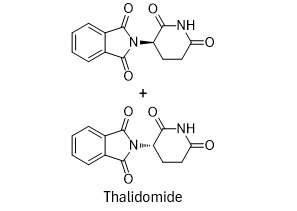 Figure 5: Enantiomers of thalidomide.
3.7. pH-Dependence and Stability
An active ingredient can be tested for stability and solubility at various pH’s. A range of pH can be determined, testing the lowest and highest pH’s at which the molecule remains stable and neutral. The ionic form tends to be more water-soluble. It may be necessary to add a buffer to the formulation to maintain a constant pH and the molecule’s stability.
For example, Naproxen in its neutral form is stable at low pH (acidic solution) and has extremely low water solubility. On the other hand, Naproxen Sodium is stable and highly soluble in water at high pH (basic solution).
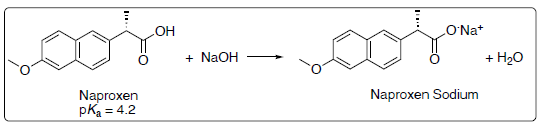 Figure 6: Acid–base reaction between naproxen and sodium hydroxide, forming naproxen sodium.
To obtain a stable Naproxen oral suspension, it is necessary to have Naproxen in its free acid form in a buffered solution, which could be a citrate buffer at pH 3.
4. Key Development Takeaways
Characterizing an active ingredient is key to success and to a quality finished product. There is a long period of time between finding an active pharmaceutical ingredient, developing a formulation, and finally manufacturing a drug product.
The work must start in the laboratory to identify the key chemical and physical properties of the active pharmaceutical ingredient to gain insight into how to formulate a drug product containing the right excipients, which will optimize solubility, maintain stability, and enhance bioavailability.
Indeed, pre-formulation studies in pharmaceutical development have become paramount to the success of a drug product manufacturing. The important aspects to study in a solid-state substance are crystallinity, polymorphism, hygroscopicity, and particle size, which all impact solubility and intrinsic dissolution rate (IDR).
A CDMO must have a well-equipped laboratory to perform all the necessary testing to rigorously characterize the API and then be ready to elaborate a sensible formulation. At Groupe PARIMA, our in-house analytical laboratory has more than a support function; it’s a core pillar of our capabilities as a CDMO.
With over three decades of pharmaceutical expertise, it delivers analytical solutions that are scientifically rigorous, regulatory-compliant, and tailored to the unique needs of small molecule drug development.
Thorough formulation development and careful planning will pay off in the long run, reducing cost and time.
5. Next Steps and Drug Product Lifecycle
In subsequent content, we will explore the formulation of drug products, drug product scale-up, and technical transfer.
There are several strategies to extend the lifecycle of a drug product, for example, developing a new formulation, a new dosage form, a new indication, or the development of a combination of drug products.
Formulation expertise is an asset for a CDMO; again, the work laid out in characterizing the API can facilitate the work required to diversify a drug product portfolio.
The scale-up stage also requires know-how to rework the formulation as needed to maintain the qualities initially defined for the drug product. For instance, the choice of equipment, size or shape, can impact the homogenous mixing of the API and excipients.
The team must be agile in making appropriate adjustments, for example, mixing speed or temperature control. At every stage, the final drug product will be characterized and put on stability to confirm the success of the scale-up.
Finally, skills in technology transfer allow CDMO to take on projects at any stage, whether it is at the development stage or at the manufacturing stage. Technology transfer can be for a new drug in development, as well as for generic drug development.